Unit 4: Free Energy Relationships
The Hammett Equation. The
correlation of reaction equilibria and rates with changes in structure is a
major goal of chemistry. In organic chemistry, the change in an equilibrium
constant, K, or a rate constant, k,
which results from the substitution of a specific group for hydrogen,
the so-called substituent effect,
is of special interest. Professor L.P. Hammett, of Columbia University,
systematized much of the research in this area by defining a quantity s (the substituent constant) for any given
substituent.as follows:

where Ko
is the acid dissociation constant for the ionization of benzoic acid and
K is the acid dissociation constant for the ionization of a substituted benzoic
acid with a given substituent at a given position on the aromatic ring. Since
log Ko is directly related to the standard free energy change
accompanying the ionization of benzoic acid (via DGo = -2.303RTlog Ko
), and log K is directly related to the standard free energy change accompanying
the ionization of the substituted benzoic acid, the substituent constant is
actually related to DDGo, the difference in
the free energy changes for the two ionization processes, i.e., a measure of
the substituent effect expressed in terms of a free energy quantity. Since the
K’s depend somewhat upon the temperature and critically upon the nature
of the solvent, s
is defined specifically for water at 25 oC.
Also, since the
magnitude of the subtituent effect depends upon the position of the subsituent
upon the aromatic ring, there are different substituent constants for para, meta, and ortho substituents. Typically, these
are distinguished as sp
, sm , and so
. If the ratio (K/ Ko) >1, i.e.,
the substituent has increased the acidity of the benzoic acid, s is
positive. Such a substituent is considered to be an electron-withdrawing
group (EWG),
because electron density is increased at the reaction site in the product
benzoate anion, and an EWG will favor this change by withdrawing electron
density away away from the reaction site. Groups such as m-Cl, p-Cl, m-NO2,
p-NO2, etc. which have relatively large dipole moments oriented with
the positive end directed toward the reaction site are EWG’s. On the
other hand, electron donating groups (groups which tend to increase the
electron density near the reaction site) disfavor the ionization to a
negatively charged ion and have K/Ko<1. These groups have
negative sigma values. These include alkyl groups (at both the meta and para positions), para alkoxy groups, and p-amino groups. The Hammett
substituent constants for many hundreds of substituent groups have been
measured and tabulated. It should be noted that, by definition, Hammett
substituent constants are relative to hydrogen as a basis of comparison.That is
to say, sH = 0.0.
Hammett
further observed that if log (K/ Ko) for the ionization of other
acids was plotted versus these sigma values, reasonably linear plots were
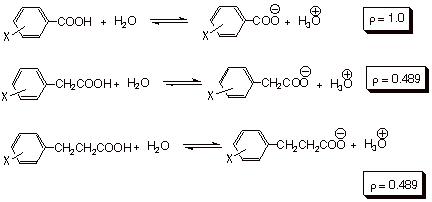
obtained. For example, if the log (K/ Ko) data for the ionization of meta and para substituted phenylacetic acids
in water at 25 oC was
plotted versus his sigma values a linear plot of slope 0.489 was obtained.
Similarly, if the data for ionization of substituted phenylpropionic acids was
plotted vs sigma, a linear plot of
slope 0.212 was obtained.
Hammett therefore proposed the equation now known by his
name:
log (K/ Ko) = rs
where
log (K/ Ko) represent the log of the relative equilibrium constants
for any reaction, with the K for the substituted reactant in the numerator and
the Ko for the unsubstituted version in the denominator. The value
of the proportionality constant, rho, depends upon the specific reaction being
studied, and was termed the reaction constant. Essentially, the Hammett
equation proposes that the relative free energy changes occasioned by the
changes in substituent are proportional the same changes in the benzoic acid
series, or for that matter to any other series of equilibria. The magnitude of
rho, in effect, determines how large the free energy changes are in a reaction
series, that is, how large the substituent effects are. If K>1, the
substituent effects are larger than in the standard benzoic acid ionization. If
K<1, the substituent effects are smaller than in the standard reaction. We
can easily see that the substituent effects are smaller for the arylpropionic
acid series than for the arylacetic acid series, than for the standard
reaction. Essentially this is because the change in electron density occasioned
by the loss of a proton for the carboxyl group, although the same in each of
these reaction series, is closest to the substituent and the aryl ring in the
standard series and most remote in the arylpropionic acid series. The
substituent effect is thus least in the latter series because of the remoteness
of the reaction site from the substituent and the aryl ring.
In
the ionization of phenols, the negative charge is generated at a benzylic-type
position, i.e., it is generated on an atom (oxygen) which is directly attached
to the ring. The rho value for the ionization of substituted phenols in water
at 25 oC is, correspondingly greater than that for the standard
benzoic acid ionization (2.1)
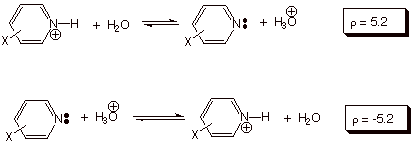
When the reaction site is actually in the aromatic ring,
the substituent effects, as reflected by the rho value, are even larger than in
the standard reaction series. This is seen in the ionization of substituted
pyridinium ions in water at 25 oC, where r = +5.2. Incidentally, the second equation below
indicates that the rho value for the reverse of a reaction has the opposite
sign, but the same magnitude as for the forward reaction. In general reactions,
like the standard reaction, in which electron density is increase at the
reaction site, have positive rho values (posite rho may be taken as a positive
increase in electron density). Reactions in which the electron density at the
reaction center is decreased in going from reactant to product have negative
rho values. The seoncd equation
below is an example of the latter kind, in which a positive charge is generated
at the reaction site. From the first equation below we should note that
electron density increases do not require the development of a negative charge.
The removal of a positive charge is equally as good at increasing electron
density.
We have seen that rho values depend quantitatively upon the distance of the electron density change from the aryl ring. They also depend, of course, upon the magnitude of the electron density change. The development of partial negative charges is best seen in a context of the correlation of reaction rates with substituent constants (see below). However, a similar effect can be seen in the dependence of the magnitude of rho, for a given reaction, upon the nature of the solvent. As we have seen, the rho value (by definition) for the standard reaction series (in water) is 1.0. If the solvent is changed to methanol, the rho value increases by about 50%, to 1.54. In solvent ethanol it increases to almost twice the value in water (1.96). In acetonitrile, a further increase to 2.8 is observed. Clearly, solvation has a major effect on the magnitude of substituent effects, being largest when the carboxylate ion is not as highly solvated by hydrogen bonding. In effect, hydrogen bonding to the carboxylate ion partially quenches the unit negative charge on the carboxylate anion. Consequently, the rho value is least in water, the best hydrogen bonding solvent of all.
Correlation
of Reaction Rates with Hammett s Values. In an entirely similar way, relative rate constants for various
reaction series can be correlated with substituent constants. In this case, of
course, the free energy changes referred to are between reactant and transition
state. Once again, if electron density is increased in the TS relative to the
reactant, positive rho values are expected, i.e., electron withdrawing groups
will accelerate the reaction. If electron density is decreased, EDG’s
will speed the reaction. The Hammet equation as applied to relative reaction
rates would be expressed as follows:
log (k/ ko) = rs
where,
as before, k is the rate constant for the substituted version of the reactant
and ko is the rate constant for the unsubstituted version of the
reactant (X = H). As before, larger rho values can correspond to electron
density changes which are closer to the aryl ring, but in the case of
transition states, also to larger changes in electron density. This is because
transition states can have partial charges.
The
Substituent Constants.